
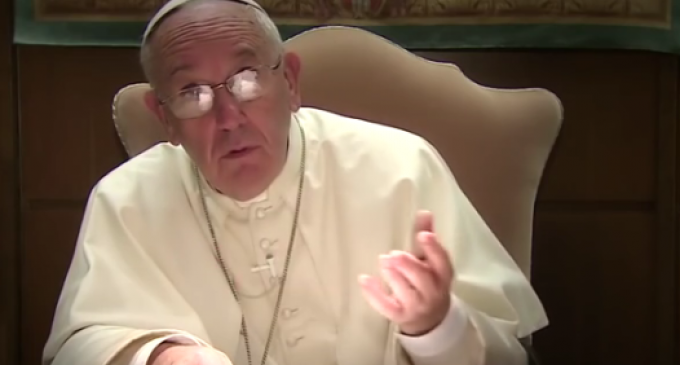
Pope Francis is one of the biggest propaganda pieces of the New World Order. Just take his “vision“ for a One World Religion, which actually means to exploit all types of religious worshipers who will buy into this deceit.
According to Infowar‘s Alex Jones, the Vatican is feeding into a power hungry elitist agenda by ultimately destroying its own institution, but the millions of people who follow the pope’s guidance do not realize this.
Leo Zagami, who is highly involved in the Vatican, and with the higher level secret societies in Rome has warned the public for years about a pope who will preach that all religions worship the same god. You can watch Pope Francis’ unified religion trailer on the next page.
As a best selling author, Zagami has also warned over the coming of a “black, Jesuit pope,“ or this new pope, Pope Francis, who will probably resign and set a precedent for future popes to only serve for five to ten years, or less, or even suggest something as crazy as multiple popes.
Watch and Read more on the next page.

IDIOT DELUX.
Mary didn’t have other Children. we must understand that the term brother has a wide semantic range in Scripture. It can mean a uterine brother, an extended relative, or even a spiritual brother. In Genesis 13:8 and 14:12, we read of one example of brother being used to describe an extended relationship: Abraham and Lot. Though they were actually uncle and nephew, they called one another “brother.” Moreover, in the New Testament, Jesus told us to call one another “brothers” in Matthew 23:8. The passage obviously does not mean to suggest that all Christians have the same physical mother.
Second, if we examine more closely the example of James, one of these four “brothers of the Lord” mentioned in Matthew 13:55, we discover him to be a cousin or some other relative of Jesus rather than a uterine brother. For example, Galatians 1:18-19 informs us: “Then after three years I [Paul] went up to Jerusalem to visit Cephas, and remained with him fifteen days. But I saw none of the other apostles except James the Lord’s brother.”
Notice, the “James” of whom Paul was speaking was both a “brother of the Lord” and an “apostle.” There are two apostles named James among the 12. The first James is revealed to be a “son of Zebedee.” He most likely would not be the “James” referred to because according to Acts 12:1-2 he was martyred very early on. Even if it was him, his father was named Zebedee, not Joseph.
Paul more likely is referring to the second James who was an apostle, according to Luke 6:15-16. This James is revealed to have a father named Alphaeus, not Joseph. Thus, James the apostle and Jesus were not uterine brothers. Easy enough. Some will argue, however, that this “James” was not an apostle or that he was not one of the original 12. Though this is a possibility—others in the New Testament, such as Barnabas in Acts 14, are referred to as “apostles” in a looser sense—the argument from Scripture is weak. When Paul wrote about going “up to Jerusalem” to see Peter, he was writing about an event that occurred many years earlier, shortly after he had converted. He was basically going up to the apostles to receive approval lest he “should be running or had run in vain.” It would be more likely he would have here been speaking about “apostles” (proper), or “the twelve.
Browse
Blog
Library
Video
Radio
Speakers
Forums
Shop
Donate
About
Tracts
tracts home
browse tracts
Mary: Ever Virgin
Most Protestants claim that Mary bore children other than Jesus. To support their claim, these Protestants refer to the biblical passages which mention the “brethren of the Lord.” As explained in the Catholic Answers tract Brethren of the Lord, neither the Gospel accounts nor the early Christians attest to the notion that Mary bore other children besides Jesus. The faithful knew, through the witness of Scripture and Tradition, that Jesus was Mary’s only child and that she remained a lifelong virgin.
An important historical document which supports the teaching of Mary’s perpetual virginity is the Protoevangelium of James, which was written probably less than sixty years after the conclusion of Mary’s earthly life (around A.D. 120), when memories of her life were still vivid in the minds of many.
According to the world-renowned patristics scholar, Johannes Quasten: “The principal aim of the whole writing [Protoevangelium of James] is to prove the perpetual and inviolate virginity of Mary before, in, and after the birth of Christ” (Patrology, 1:120–1).
To begin with, the Protoevangelium records that when Mary’s birth was prophesied, her mother, St. Anne, vowed that she would devote the child to the service of the Lord, as Samuel had been by his mother (1 Sam. 1:11). Mary would thus serve the Lord at the Temple, as women had for centuries (1 Sam. 2:22), and as Anna the prophetess did at the time of Jesus’ birth (Luke 2:36–37). A life of continual, devoted service to the Lord at the Temple meant that Mary would not be able to live the ordinary life of a child-rearing mother. Rather, she was vowed to a life of perpetual virginity.
However, due to considerations of ceremonial cleanliness, it was eventually necessary for Mary, a consecrated “virgin of the Lord,” to have a guardian or protector who would respect her vow of virginity. Thus, according to the Protoevangelium, Joseph, an elderly widower who already had children, was chosen to be her spouse. (This would also explain why Joseph was apparently dead by the time of Jesus’ adult ministry, since he does not appear during it in the gospels, and since Mary is entrusted to John, rather than to her husband Joseph, at the crucifixion).
According to the Protoevangelium, Joseph was required to regard Mary’s vow of virginity with the utmost respect. The gravity of his responsibility as the guardian of a virgin was indicated by the fact that, when she was discovered to be with child, he had to answer to the Temple authorities, who thought him guilty of defiling a virgin of the Lord. Mary was also accused of having forsaken the Lord by breaking her vow. Keeping this in mind, it is an incredible insult to the Blessed Virgin to say that she broke her vow by bearing children other than her Lord and God, who was conceived through the power of the Holy Spirit.
The perpetual virginity of Mary has always been reconciled with the biblical references to Christ’s brethren through a proper understanding of the meaning of the term “brethren.” The understanding that the brethren of the Lord were Jesus’ stepbrothers (children of Joseph) rather than half-brothers (children of Mary) was the most common one until the time of Jerome (fourth century). It was Jerome who introduced the possibility that Christ’s brethren were actually his cousins, since in Jewish idiom cousins were also referred to as “brethren.” The Catholic Church allows the faithful to hold either view, since both are compatible with the reality of Mary’s perpetual virginity.
Today most Protestants are unaware of these early beliefs regarding Mary’s virginity and the proper interpretation of “the brethren of the Lord.” And yet, the Protestant Reformers themselves—Martin Luther, John Calvin, and Ulrich Zwingli—honored the perpetual virginity of Mary and recognized it as the teaching of the Bible, as have other, more modern Protestants.
The Protoevangelium of James
“And behold, an angel of the Lord stood by [St. Anne], saying, ‘Anne! Anne! The Lord has heard your prayer, and you shall conceive and shall bring forth, and your seed shall be spoken of in all the world.’ And Anne said, ‘As the Lord my God lives, if I beget either male or female, I will bring it as a gift to the Lord my God, and it shall minister to him in the holy things all the days of its life.’ . . . And [from the time she was three] Mary was in the temple of the Lord as if she were a dove that dwelt there” (Protoevangelium of James 4, 7 [A.D. 120]).
“And when she was twelve years old there was held a council of priests, saying, ‘Behold, Mary has reached the age of twelve years in the temple of the Lord. What then shall we do with her, lest perchance she defile the sanctuary of the Lord?’ And they said to the high priest, ‘You stand by the altar of the Lord; go in and pray concerning her, and whatever the Lord shall manifest to you, that also will we do.’ . . . [A]nd he prayed concerning her, and behold, an angel of the Lord stood by him saying, ‘Zechariah! Zechariah! Go out and assemble the widowers of the people and let them bring each his rod, and to whomsoever the Lord shall show a sign, his wife shall she be. . . . And Joseph [was chosen]. . . . And the priest said to Joseph, ‘You have been chosen by lot to take into your keeping the Virgin of the Lord.’ But Joseph refused, saying, ‘I have children, and I am an old man, and she is a young girl’” (ibid., 8–9).
“And Annas the scribe came to him [Joseph] . . . and saw that Mary was with child. And he ran away to the priest and said to him, ‘Joseph, whom you did vouch for, has committed a grievous crime.’ And the priest said, ‘How so?’ And he said, ‘He has defiled the virgin whom he received out of the temple of the Lord and has married her by stealth’” (ibid., 15).
“And the priest said, ‘Mary, why have you done this? And why have you brought your soul low and forgotten the Lord your God?’ . . . And she wept bitterly saying, ‘As the Lord my God lives, I am pure before him, and know not man’” (ibid.).
According to the Protoevangelium, Joseph was required to regard Mary’s vow of virginity with the utmost respect. The gravity of his responsibility as the guardian of a virgin was indicated by the fact that, when she was discovered to be with child, he had to answer to the Temple authorities, who thought him guilty of defiling a virgin of the Lord. Mary was also accused of having forsaken the Lord by breaking her vow. Keeping this in mind, it is an incredible insult to the Blessed Virgin to say that she broke her vow by bearing children other than her Lord and God, who was conceived through the power of the Holy Spirit.
The perpetual virginity of Mary has always been reconciled with the biblical references to Christ’s brethren through a proper understanding of the meaning of the term “brethren.” The understanding that the brethren of the Lord were Jesus’ stepbrothers (children of Joseph) rather than half-brothers (children of Mary) was the most common one until the time of Jerome (fourth century). It was Jerome who introduced the possibility that Christ’s brethren were actually his cousins, since in Jewish idiom cousins were also referred to as “brethren.” The Catholic Church allows the faithful to hold either view, since both are compatible with the reality of Mary’s perpetual virginity.
WRONG !!!!!
This is very false.
Your crazy
Better think again Dummy.
Yeah ,right !…what an idiot !
Although Allah dose mean God in Aribic, knowing this is likely the same God. How we get to our eternal destination is very different. The Bible mentions to be aware of false prophets. Me being of the Christian faith believes Mohomad is one of these prophets. If you look at other Religeons their God’s are very different.