
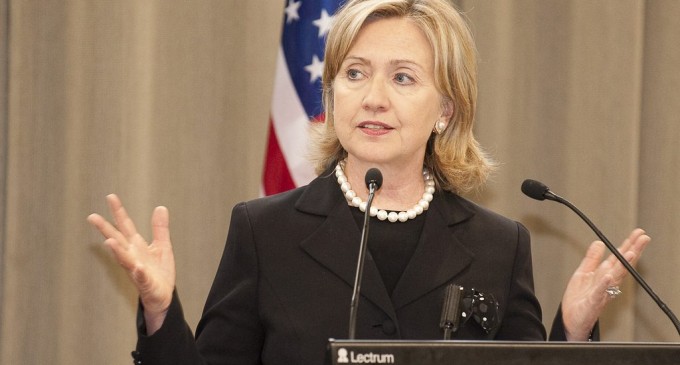
Former Secretary of State Hillary Clinton’s story as to her use of a private email while leading the State Department from 2009 to 2013 has evolved more times than her view on gay marriage and the Keystone XL Pipeline put together. Clinton initially claimed that she only used one device — she used many. She claimed she never sent any classified information — she did. She then modified her stance to claim that she never sent anything that was classified at the time — not true either. Clinton also told the FBI and the American people that she turned over all work-related emails — the FBI found that she never turned over (and deleted) a number of work-related emails.
It’s no wonder the American people can’t keeping the Democratic presidential nominee’s story straight — SHE can’t keep it straight, either.
Clinton’s latest claim — one which she made this week, on 60 Minutes — is that she used a private email server because “other secretaries of state” and “high-ranking members of administrations” recommended the idea to her.
But who were these “high ranking” officials and former secretaries of state? Did anybody actually tell her that this was a good idea, or is Clinton simply attempting to shift blame for her “extremely careless” behavior?
To read more, continue on the next page:

Lies, vote, TRUMP-PENCE.
Oooooooh K. I’m buying that one for sure since u said so. Thanx for clearing that up!
By Bill?
who are you throwing under hte bus now hillary
Then I recommend rat poison , straight up bitch
The story keeps changing. Before she was very firm in her testimony that she used a private server for her own convenience. Now she states that she received a recommendation but say from whom.
By who? Trump? Is it his fault. Maybe the Russians?
18 U.S.C. § 208: Acts affecting a personal financial interest
18 U.S.C. § 208, the basic criminal conflict of interest statute, prohibits an executive branch employee from participating personally and substantially in a particular Government matter that will affect his own financial interests, as well as the financial interests of:
His spouse or minor child;
His general partner;
An organization in which he serves as an officer, director, trustee, general partner or employee; and
A person with whom he is negotiating for or has an arrangement concerning prospective employment.
Financial Interests in a Particular Matter
An employee has a disqualifying financial interest in a particular matter only if there is a close causal link between a particular Government matter in which the employee participates and any effect on the asset or other interest (direct effect) and if there is a real possibility of gain or loss as a result of development in or resolution of that matter (predictable effect). Gain or loss need not be probable. The possibility of a benefit or detriment must be real, not speculative. One common point of confusion is distinguishing between an asset or other interest and a financial interest in a particular matter under 18 U.S.C. § 208. The financial interest is the possibility of gain or loss (of the value of an asset or other interest) resulting from a particular matter, not the asset or interest itself. Thus, a person could have a large holding but only a relatively small financial interest in the particular matter, because the potential for gain or loss is small.
Exemptions
The criminal prohibition has no de minimis level. That is, it applies where any financial interest exists, no matter how small. Under 18 U.S.C. § 208(b)(2), however, OGE has the authority to establish blanket exemptions for financial interests considered too remote or too inconsequential to affect the integrity of the employee’s services. OGE has established several exemptions. The exemptions can be found in the implementing regulation for the statute, 5 C.F.R. part 2640. An employee who qualifies for an exemption can participate in official matters without violating 18 U.S.C. § 208, even though he has what would otherwise be a disqualifying financial interest in the matters. In addition to the exemptions established by OGE, there is an exception in the statute itself at 18 U.S.C. § 208(b)(4) for employees that have certain Native American or Alaska Native birthrights. If the financial interest that would be affected by the particular matter is that resulting solely from the interest of employee or the spouse or minor children in certain Native American or Alaska Native birthrights, the employee may participate in the particular matter without violating 18 U.S.C. § 208.
Waivers
The criminal financial conflict of interest statute has two separate waiver provisions. An employee who has been granted a waiver can participate in official matters without violating 18 U.S.C. § 208, even though he has what would otherwise be a disqualifying financial interest in the matters. Ethics officials often use waivers for broad particular matters, such as general policy matters, in conjunction with a recusal from particular matters involving specific parties for a specific financial interest. The two types of waivers are:
208(b)(1): A waiver issued by the employee’s agency that covers certain financial interests that are not so substantial as to affect the integrity of the employee’s services.
208(b)(3): A waiver for special government employees on Federal Advisory Committee Act committees when the need for services outweighs the potential for conflicts.
Your a Liar killary and always be one Liar. go to prison and stay there.
Liar