
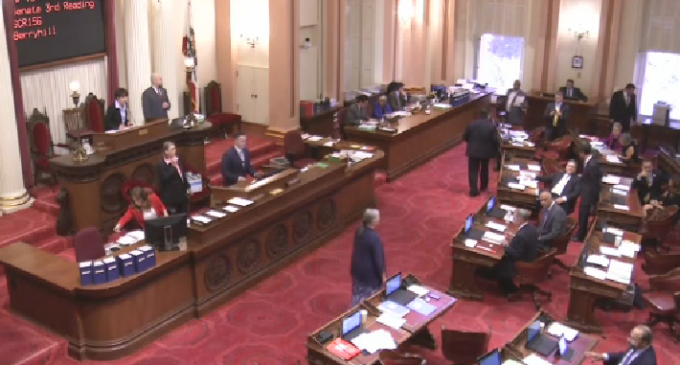
One of the biggest problems American voters have with politicians is that they seem to agree to one set of rules to which ordinary Americans must adhere and a completely different set for themselves. Americans have seen this time and time (and time) again, and it is one of the reasons that candidates such as Donald Trump and Bernie Sanders garner such enthusiastic support. It is also the reason that Hillary Clinton finds herself in hot water with the FBI right now.
Hillary Clinton and former President Bill Clinton are exhibits A-Z on political hypocrisy. Even though Hillary Clinton mandated that everyone in her State Department use a @state.gov email address for official business, she did not. While the Clintons are the prime example of hypocrisy, they are far from the only one. Members of Congress who supported the Affordable Care Act (Obamacare) quietly granted themselves and their staff waivers from the government-run exchanges.
Now, the California State Senate has voted overwhelmingly to exempt itself from harsh gun laws that it chose to impose upon its own constituents.
To read more — and to learn how California is not the only state doing this — continue reading on the next page:

If they make & pass a law, they need to abide by it also. This is why things are in such a mess.
2 faced much?
What happened to Congress shall pass no law exempting them selfs…… Obamacare…
“Society in every state is a blessing, but government even in its best state is but a necessary evil; in its worst state an intolerable one; for when we suffer, or are exposed to the same miseries by a government, which we might expect in a country without government, our calamity is heightened by reflecting that we furnish the means by which we suffer…”
― Thomas Paine, Common Sense
Typical
Guess the Cali leaders don’t fear their constituent vote…follow the money people….follow the money.
Whaaaaat? Stupid
OH,HELL NO!!!!!
Oh Hell No. If you are going to make a law it applies to you to.
Hate crimes? ))(( Noah Webster ((knew 26 languages, & was admitted to practice law in the Supreme Court)) defines online: HA’TRED, n. Great dislike or aversion; hate; enmity. Hatred is an aversion to evil, and may spring from utter disapprobation, as the hatred of vice or meanness; or it may spring from offenses or injuries done by fellow men, or from envy or jealousy, in which case it is usually accompanied with malevolence or malignity. Extreme hatred is abhorrence or detestation.)( MUR’DER, n. [L. mors.]
1. The act of unlawfully killing a human being with premeditated malice, by a person of sound mind. To constitute murder in law, the person killing another must be of sound mind or in possession of his reason, and the act must be done with malice prepense, aforethought or premeditated; but malice may be implied, as well as express.
2. An outcry, when life is in danger.
MUR’DER, v.t.
1. To kill a human being with premeditated malice. [See the Noun.]
2. To destroy; to put an end to.)(FEL’ONY, n. [See Felon.] In common law, any crime which incurs the forfeiture of lands or goods. Treason was formerly comprised under the name of felony, but is now distinguished from crimes thus denominated, although it is really a felony. All offenses punishable with death are felonies; and so are some crimes not thus punished, as suicide, homicide by chance-medley, or in self-defense, and petty larceny. Capital punishment therefore does not necessarily enter into the true idea or definition of felony; the true criterion of felony being forfeiture of lands or goods. But the idea of felony has been so generally connected with that of capital punishment, that law and usage now confirm that connection. Thus if a statute makes any new offense a felony, it is understood to mean a crime punishable with death.
Canst thou murder thy breath in middle of a word?)(