
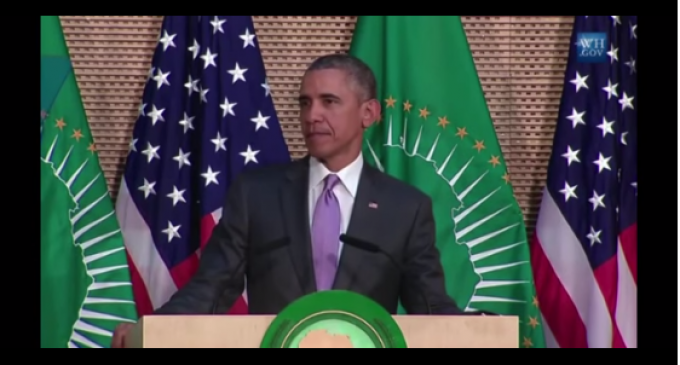
“Many a true word is spoken in jest”
Geoffrey Chaucer is thought to be the first express this idea. Shakespeare later wrote in King Lear in 1605:
“Jesters do oft prove prophets”
Let’s hopè that Obama isn’t about to prove himself a ‘prophet’ with his recent comment about being the President after 2016. Many speculate that he will remain in office after the United States suffers an ’emergency’, which would permit him to suspend elections.
See Following Page:

i know he can not by law but they have done so much that is against the law and get away with it
REVOLUTION is in the air.
Of course that’s why he’s planning to stay in Washington.
Maybe he was counting on Hillary winning and then a retrial done and found her guilty so it was passed back to him as President.
Obama belongs in prison for treason
He says: “the law’s the law!” Yeah, that’s exactly what he’s known for – following the spirit and letter of the law!
dangerous fool! And the constitution?
Terror operates on fear & ignorance! Quote from Pg.12 of the Citizens Rule Book, Jury Handbook: “There is nothing more terrifying than ignorance in action.” By Goethe –engraved on Plaque at the Naval War College.(( N. Webster Dict. Online defines: BIG’OT, n.
1. A person who is obstinately and unreasonably wedded to a particular religious creed, opinion, practice or ritual. The word is sometimes used in an enlarged sense, for a person who is illiberally attached to any opinion, or system of belief; as a bigot to the Mohammedan religion; a bigot to a form of government…( IG’NORANCE, n. [L. ignorantia; ignoro,not to know; ignarus, ignorant; in and gnarus, knowing.]
1. Want, absence or destitution of knowledge; the negative state of the mind which has not been instructed in arts, literature or science, or has not been informed of facts. Ignorance may be general, or it may be limited to particular subjects. Ignorance of the law does not excuse a man for violating it. Ignorance of facts if often venial.
Ignorance is preferable to error.
2. Ignorances, in the plural, is used sometimes for omissions or mistakes; but the use is uncommon and not to be encouraged.( FEAR, n. [See the Verb.]
1. A painful emotion or passion excited by an expectation of evil, or the apprehension of impending danger. Fear expresses less apprehension than dread, and dread less than terror and fright. The force of this passion, beginning with the most moderate degree, may be thus expressed, fear, dread, terror, fright. Fear is accompanied with a desire to avoid or ward off the expected evil. Fear is an uneasiness of mind, upon the thought of future evil likely to befall us.
Fear is the passion of our nature which excites us to provide for our security, on the approach of evil.
2. Anxiety; solicitude.
The principal fear was for the holy temple.
3. The cause of fear.
Thy angel becomes a fear.
4. The object of fear.
Except the God of Abraham, and the fear of Isaac, had been with me. Gen 31.
5. Something set or hung up to terrify wild animals, by its color or noise. Is. 24. Jer. 48.
6. In scripture, fear is used to express a filial or a slavish passion. In good men, the fear of God is a holy awe or reverence of God and his laws, which springs from a just view and real love of the divine character, leading the subjects of it to hate and shun every thing that can offend such a holy being, and inclining them to aim at perfect obedience. This is filial fear.
I will put my fear in their hearts. Jer. 32.
Slavish fear is the effect or consequence of guilt; it is the painful apprehension of merited punishment. Rom. 8.
The love of God casteth out fear. 1John 4.
7. The worship of God.
I will teach you the fear of the Lord. Ps. 34.
8. The law and word of God.
The fear of the Lord is clean, enduring for ever. Ps. 19.
9. Reverence; respect; due regard.
Render to all their dues; fear to whom fear. Rom. 13.
FEAR, v.t. [L. vereor.]
1. To feel a painful apprehension of some impending evil; to be afraid of; to consider or expect with emotions of alarm or solicitude. We fear the approach of an enemy or of a storm. We have reason to fear the punishment of our sins.
I will fear no evil, for thou art with me. Ps. 23.
2. To reverence; to have a reverential awe; to venerate.
This do, and live: for I fear God. Gen. 42.
3. To affright; to terrify; to drive away or prevent approach by fear, or by a scarecrow. [This seems to be the primary meaning, but now obsolete.]
We must not make a scarecrow of the law, setting it up to fear the birds of prey.
FEAR, v.i. To be in apprehension of evil; to be afraid; to feel anxiety on account of some expected evil.
But I fear, lest by any means, as the serpent beguiled Eve through his subtility, so your minds should be corrupted from the simplicity that is in Christ. 2Cor. 11.
Fear not, Abram: I am thy shield, and thy exceeding great reward. Gen. 15.
FEAR, n. A companion. [Not in use. See Peer.]
If Hillary doesn’t get elected the Bilderberg group will allow it.
Vote trump